-
SolutionsOUR TECHNOLGY & OUR SOLUTIONSState-of-the-art technology and pragmatic solutions for a global management of your controls by image, for a specific response to your project and to the extent of your needs.
-
Machine vision for MANUFACTURERSApplications dedicated to each type of control: Quality control - Compliance control - Production and manufacturing process control - Production environment controlLire plus
-
Machine vision or INTEGRATORS & MACHINES MANUFACTURERSOur expertise in collaborative mode for the integration of our technology in your installation projects.Lire plus
-
Camera based-vision for SERVICE COMPANIESImage control solutions for your maintenance operations and delegated management of machine parks, technical networks, etc.Lire plus
-
Image Analysis for RESEARCH CENTERSState-of-the-art detection and tracking algorithms that can be configured in seconds and are used by many researchers and engineers in multiple fields.Lire plus
-
-
ApplicationsAPPLICATIONSApplications developed to specifications or by your R&D departments, with our support, thanks to our AX Vision and AX R&D software solutions.
-
Appearance inspectionSurface finish inspection - Colorimetric - Compliance - Profilometry ...Lire plus
-
Parts sortingClassification by product family, by type of defect - PairingLire plus
-
Robot guidancePalletizing / Depalletizing - Unpicking - Picking - Assembly...Lire plus
-
Dimensional measurementDiameter - Distance - Thickness - XYZ - LocationLire plus
-
TracabilityProduction and production environment event dataLire plus
-
LogisticPalletizing / De-palletizing - Residence time - OCR Datamatric / QR-code readingLire plus
-
Tool breakage detectionMonitoring of machine tools with reporting to the operator and traceability of eventsLire plus
-
OCR / Datamatrix / QR-codes readingProduct traceability Compliance by OCR / Datamatrix / QR-codes / DLC reading...Lire plus
-
-
Fields & marketsFIELDS & MARKETSTo control the quality and conformity of the raw material to the refined product, until its packaging. To control and guide the production. To control the production environment. To ensure traceability.
-
Agri-foodGranulometry, shape, texture, colorimetry, destructuring, DATAMATRIX / QR Code / OCR reading, verification of use-by dates, traceability, packaging, input detection.......Lire plus
-
TextileAutomatic detection of defects on the run: colorimetric control, aspect control, pattern control, stitch and/or yarn defectsLire plus
-
MetallurgyControl of lack/overflow of material, dimensional control of molds, sorting of parts, structural defects...Lire plus
-
MechanicalDetection of machining defects: dimensions, materials, shapes, aspects - Management by the vision of the manufacturing process and the machine parkLire plus
-
Wire drawingControl of wire sections, cable, glass fiber... - Verification of multi-strand braiding - Structural control of sheaths - Control of winding...Lire plus
-
cosmeticsDefect inspection for compliance control: surface aspect, texture, material, colorimetry, lack or overflow of material, positioning, granulometry (powder), fluidity (gel), etc.Lire plus
-
AutomotiveControl of parts (dimensions, lack/overflow of material, surface aspect...) - Assembly robot guidance - Traceability of production process and partsLire plus
-
Plasturgy & rubberControl of colorimetry, lack/overflow of material, dimensional control of molds, structural defects, sorting of parts...Lire plus
-
GlassDimensional control - Shape analysis - Pattern and gilding conformity - Inclusion detection (bubbles, threads, foreign bodies...) - Colorimetry...Lire plus
-
LogisticTraceability for article tracking (OCR and Datamatrix reading) - 3D vision for palletizing robot guidance - Packaging integrity compliance...Lire plus
-
Medical & HealthMedical device controls, quality and compliance monitoring: prosthesis, catheter, support stockings, biological kit, drug packaging, etc.Lire plus
-
Research & DevelopmentImage analysis: microscopy, optics, electronics - Ultra high speed camera - Tomography - Sonar...Lire plus
-
-
SolutionsOUR TECHNOLGY & OUR SOLUTIONSState-of-the-art technology and pragmatic solutions for a global management of your controls by image, for a specific response to your project and to the extent of your needs.
-
Machine vision for MANUFACTURERSApplications dedicated to each type of control: Quality control - Compliance control - Production and manufacturing process control - Production environment controlLire plus
-
Machine vision or INTEGRATORS & MACHINES MANUFACTURERSOur expertise in collaborative mode for the integration of our technology in your installation projects.Lire plus
-
Camera based-vision for SERVICE COMPANIESImage control solutions for your maintenance operations and delegated management of machine parks, technical networks, etc.Lire plus
-
Image Analysis for RESEARCH CENTERSState-of-the-art detection and tracking algorithms that can be configured in seconds and are used by many researchers and engineers in multiple fields.Lire plus
-
-
ApplicationsAPPLICATIONSApplications developed to specifications or by your R&D departments, with our support, thanks to our AX Vision and AX R&D software solutions.
-
Appearance inspectionSurface finish inspection - Colorimetric - Compliance - Profilometry ...Lire plus
-
Parts sortingClassification by product family, by type of defect - PairingLire plus
-
Robot guidancePalletizing / Depalletizing - Unpicking - Picking - Assembly...Lire plus
-
Dimensional measurementDiameter - Distance - Thickness - XYZ - LocationLire plus
-
TracabilityProduction and production environment event dataLire plus
-
LogisticPalletizing / De-palletizing - Residence time - OCR Datamatric / QR-code readingLire plus
-
Tool breakage detectionMonitoring of machine tools with reporting to the operator and traceability of eventsLire plus
-
OCR / Datamatrix / QR-codes readingProduct traceability Compliance by OCR / Datamatrix / QR-codes / DLC reading...Lire plus
-
-
Fields & marketsFIELDS & MARKETSTo control the quality and conformity of the raw material to the refined product, until its packaging. To control and guide the production. To control the production environment. To ensure traceability.
-
Agri-foodGranulometry, shape, texture, colorimetry, destructuring, DATAMATRIX / QR Code / OCR reading, verification of use-by dates, traceability, packaging, input detection.......Lire plus
-
TextileAutomatic detection of defects on the run: colorimetric control, aspect control, pattern control, stitch and/or yarn defectsLire plus
-
MetallurgyControl of lack/overflow of material, dimensional control of molds, sorting of parts, structural defects...Lire plus
-
MechanicalDetection of machining defects: dimensions, materials, shapes, aspects - Management by the vision of the manufacturing process and the machine parkLire plus
-
Wire drawingControl of wire sections, cable, glass fiber... - Verification of multi-strand braiding - Structural control of sheaths - Control of winding...Lire plus
-
cosmeticsDefect inspection for compliance control: surface aspect, texture, material, colorimetry, lack or overflow of material, positioning, granulometry (powder), fluidity (gel), etc.Lire plus
-
AutomotiveControl of parts (dimensions, lack/overflow of material, surface aspect...) - Assembly robot guidance - Traceability of production process and partsLire plus
-
Plasturgy & rubberControl of colorimetry, lack/overflow of material, dimensional control of molds, structural defects, sorting of parts...Lire plus
-
GlassDimensional control - Shape analysis - Pattern and gilding conformity - Inclusion detection (bubbles, threads, foreign bodies...) - Colorimetry...Lire plus
-
LogisticTraceability for article tracking (OCR and Datamatrix reading) - 3D vision for palletizing robot guidance - Packaging integrity compliance...Lire plus
-
Medical & HealthMedical device controls, quality and compliance monitoring: prosthesis, catheter, support stockings, biological kit, drug packaging, etc.Lire plus
-
Research & DevelopmentImage analysis: microscopy, optics, electronics - Ultra high speed camera - Tomography - Sonar...Lire plus
-

AI and Machine Vision: A Strategic Asset for Innovation at the Cattenom Nuclear Power Plant
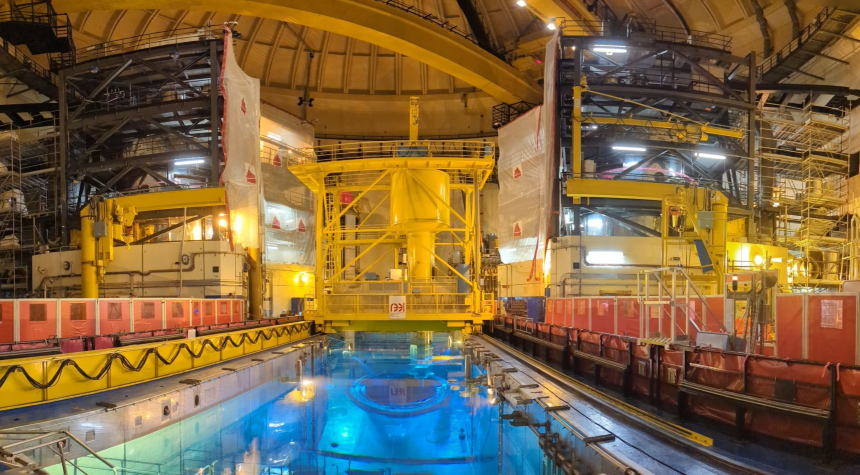
In the Grand Est region, EDF is deploying an innovative solution at its Cattenom power plant: an AI-powered machine vision system designed to assist operators during nuclear fuel reloading. This is a concrete example of technological integration that enhances safety and industrial performance.
The Cattenom nuclear power plant is one of the cornerstones of France’s nuclear fleet. With its four 1,300 MWe reactors, it alone covers 70% of the Grand Est region’s electricity needs, accounting for 8% of EDF’s national production. Every 18 months, one of the units is shut down to replace one-third of its 193 fuel assemblies contained within the reactor core.
“Optimizing nuclear safety and production”
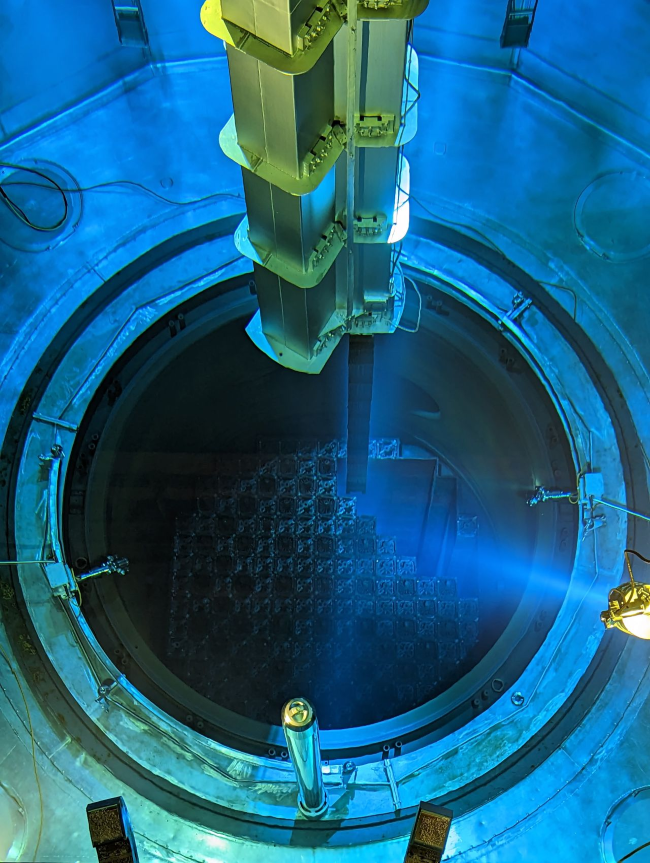
These refueling operations are subject to an extremely strict protocol established by the French Nuclear Safety and Radiation Protection Authority (ASNR). Each fuel assembly, depending on its wear, geometry, and energy potential, must be precisely repositioned within the reactor core. This is a highly precise operation carried out in a confined space.
© EDF Cattenom
“There is absolutely no room for error”
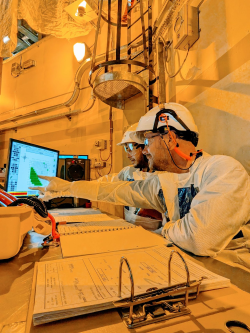
To ensure this precision, operators must visually identify the reference marks engraved on the assemblies—which are submerged nearly six meters deep in the reactor’s high-thermal-flux pool—in order to swap them out with those stored in the storage pool. This task requires sharp eyesight, extreme concentration, and consistency. This is where the Arrea solution developed by Aprex Solutions—a company specializing in machine vision and image analysis—comes in to assist the operators.
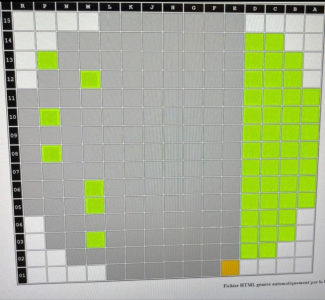
The system implemented is based on three main technologies. The first is an automatic character recognition module capable of interpreting reference numbers even under severely degraded visual conditions. The second technology involves an intelligent matching function that automatically compares the read data with the instructions transmitted by the ASNR, while integrating alerts, reminders, and a digital map of the operations performed. The third, finally, involves an inter-assembly measurement tool that verifies repositioning with a tolerance of less than 1 mm, preventing a cumulative error of 7 mm on a line.
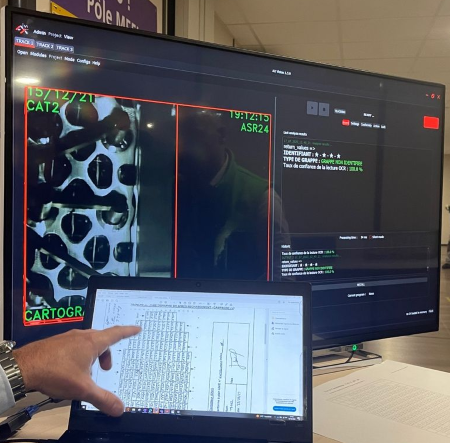
to be removed from the storage pool. © EDF Cattenom
“AI doesn’t replace the operator. It assists the operator, who then validates and logs the data.”
This solution does not replace human workers; rather, it supports them, improves operational reliability, and ensures optimal compliance within a highly secure environment.
|
|
Operators, assisted
|
MULTIPLE BENEFITS
The benefits are technical, human, and economic. Well-tailored technological support can therefore serve as a strategic lever for EDF. Overall, recharging time has been nearly cut in half. In addition, operational traceability has been enhanced and the radiation exposure of workers reduced.
AN INNOVATION SETTING THE STANDARD ACROSS THE NUCLEAR FLEET
This project won the EDF 2024 DPNT Innovation Challenge in the New Technologies and People’s Choice categories. With its philosophy of partnering with local providers of technical solutions, and through this successful integration of artificial intelligence, EDF demonstrates that innovation and synergy can be combined with the high standards of the nuclear industry. A concrete showcase of AI-assisted maintenance in critical environments. ●
APREX / EDF Cattenom Case Study
Article published in Production & Maintenance magazine
No. 90 July August September 2025 - WNE Special Report