-
SolutionsOUR TECHNOLGY & OUR SOLUTIONSState-of-the-art technology and pragmatic solutions for a global management of your controls by image, for a specific response to your project and to the extent of your needs.
-
Machine vision for MANUFACTURERSApplications dedicated to each type of control: Quality control - Compliance control - Production and manufacturing process control - Production environment controlLire plus
-
Machine vision or INTEGRATORS & MACHINES MANUFACTURERSOur expertise in collaborative mode for the integration of our technology in your installation projects.Lire plus
-
Camera based-vision for SERVICE COMPANIESImage control solutions for your maintenance operations and delegated management of machine parks, technical networks, etc.Lire plus
-
Image Analysis for RESEARCH CENTERSState-of-the-art detection and tracking algorithms that can be configured in seconds and are used by many researchers and engineers in multiple fields.Lire plus
-
-
ApplicationsAPPLICATIONSApplications developed to specifications or by your R&D departments, with our support, thanks to our AX Vision and AX R&D software solutions.
-
Appearance inspectionSurface finish inspection - Colorimetric - Compliance - Profilometry ...Lire plus
-
Parts sortingClassification by product family, by type of defect - PairingLire plus
-
Robot guidancePalletizing / Depalletizing - Unpicking - Picking - Assembly...Lire plus
-
Dimensional measurementDiameter - Distance - Thickness - XYZ - LocationLire plus
-
TracabilityProduction and production environment event dataLire plus
-
LogisticPalletizing / De-palletizing - Residence time - OCR Datamatric / QR-code readingLire plus
-
Tool breakage detectionMonitoring of machine tools with reporting to the operator and traceability of eventsLire plus
-
OCR / Datamatrix / QR-codes readingProduct traceability Compliance by OCR / Datamatrix / QR-codes / DLC reading...Lire plus
-
-
Fields & marketsFIELDS & MARKETSTo control the quality and conformity of the raw material to the refined product, until its packaging. To control and guide the production. To control the production environment. To ensure traceability.
-
Agri-foodGranulometry, shape, texture, colorimetry, destructuring, DATAMATRIX / QR Code / OCR reading, verification of use-by dates, traceability, packaging, input detection.......Lire plus
-
TextileAutomatic detection of defects on the run: colorimetric control, aspect control, pattern control, stitch and/or yarn defectsLire plus
-
MetallurgyControl of lack/overflow of material, dimensional control of molds, sorting of parts, structural defects...Lire plus
-
MechanicalDetection of machining defects: dimensions, materials, shapes, aspects - Management by the vision of the manufacturing process and the machine parkLire plus
-
Wire drawingControl of wire sections, cable, glass fiber... - Verification of multi-strand braiding - Structural control of sheaths - Control of winding...Lire plus
-
cosmeticsDefect inspection for compliance control: surface aspect, texture, material, colorimetry, lack or overflow of material, positioning, granulometry (powder), fluidity (gel), etc.Lire plus
-
AutomotiveControl of parts (dimensions, lack/overflow of material, surface aspect...) - Assembly robot guidance - Traceability of production process and partsLire plus
-
Plasturgy & rubberControl of colorimetry, lack/overflow of material, dimensional control of molds, structural defects, sorting of parts...Lire plus
-
GlassDimensional control - Shape analysis - Pattern and gilding conformity - Inclusion detection (bubbles, threads, foreign bodies...) - Colorimetry...Lire plus
-
LogisticTraceability for article tracking (OCR and Datamatrix reading) - 3D vision for palletizing robot guidance - Packaging integrity compliance...Lire plus
-
Medical & HealthMedical device controls, quality and compliance monitoring: prosthesis, catheter, support stockings, biological kit, drug packaging, etc.Lire plus
-
Research & DevelopmentImage analysis: microscopy, optics, electronics - Ultra high speed camera - Tomography - Sonar...Lire plus
-
-
SolutionsOUR TECHNOLGY & OUR SOLUTIONSState-of-the-art technology and pragmatic solutions for a global management of your controls by image, for a specific response to your project and to the extent of your needs.
-
Machine vision for MANUFACTURERSApplications dedicated to each type of control: Quality control - Compliance control - Production and manufacturing process control - Production environment controlLire plus
-
Machine vision or INTEGRATORS & MACHINES MANUFACTURERSOur expertise in collaborative mode for the integration of our technology in your installation projects.Lire plus
-
Camera based-vision for SERVICE COMPANIESImage control solutions for your maintenance operations and delegated management of machine parks, technical networks, etc.Lire plus
-
Image Analysis for RESEARCH CENTERSState-of-the-art detection and tracking algorithms that can be configured in seconds and are used by many researchers and engineers in multiple fields.Lire plus
-
-
ApplicationsAPPLICATIONSApplications developed to specifications or by your R&D departments, with our support, thanks to our AX Vision and AX R&D software solutions.
-
Appearance inspectionSurface finish inspection - Colorimetric - Compliance - Profilometry ...Lire plus
-
Parts sortingClassification by product family, by type of defect - PairingLire plus
-
Robot guidancePalletizing / Depalletizing - Unpicking - Picking - Assembly...Lire plus
-
Dimensional measurementDiameter - Distance - Thickness - XYZ - LocationLire plus
-
TracabilityProduction and production environment event dataLire plus
-
LogisticPalletizing / De-palletizing - Residence time - OCR Datamatric / QR-code readingLire plus
-
Tool breakage detectionMonitoring of machine tools with reporting to the operator and traceability of eventsLire plus
-
OCR / Datamatrix / QR-codes readingProduct traceability Compliance by OCR / Datamatrix / QR-codes / DLC reading...Lire plus
-
-
Fields & marketsFIELDS & MARKETSTo control the quality and conformity of the raw material to the refined product, until its packaging. To control and guide the production. To control the production environment. To ensure traceability.
-
Agri-foodGranulometry, shape, texture, colorimetry, destructuring, DATAMATRIX / QR Code / OCR reading, verification of use-by dates, traceability, packaging, input detection.......Lire plus
-
TextileAutomatic detection of defects on the run: colorimetric control, aspect control, pattern control, stitch and/or yarn defectsLire plus
-
MetallurgyControl of lack/overflow of material, dimensional control of molds, sorting of parts, structural defects...Lire plus
-
MechanicalDetection of machining defects: dimensions, materials, shapes, aspects - Management by the vision of the manufacturing process and the machine parkLire plus
-
Wire drawingControl of wire sections, cable, glass fiber... - Verification of multi-strand braiding - Structural control of sheaths - Control of winding...Lire plus
-
cosmeticsDefect inspection for compliance control: surface aspect, texture, material, colorimetry, lack or overflow of material, positioning, granulometry (powder), fluidity (gel), etc.Lire plus
-
AutomotiveControl of parts (dimensions, lack/overflow of material, surface aspect...) - Assembly robot guidance - Traceability of production process and partsLire plus
-
Plasturgy & rubberControl of colorimetry, lack/overflow of material, dimensional control of molds, structural defects, sorting of parts...Lire plus
-
GlassDimensional control - Shape analysis - Pattern and gilding conformity - Inclusion detection (bubbles, threads, foreign bodies...) - Colorimetry...Lire plus
-
LogisticTraceability for article tracking (OCR and Datamatrix reading) - 3D vision for palletizing robot guidance - Packaging integrity compliance...Lire plus
-
Medical & HealthMedical device controls, quality and compliance monitoring: prosthesis, catheter, support stockings, biological kit, drug packaging, etc.Lire plus
-
Research & DevelopmentImage analysis: microscopy, optics, electronics - Ultra high speed camera - Tomography - Sonar...Lire plus
-

How did the Lorraine-based company Aprex Solutions use artificial intelligence before AI became all the rage?
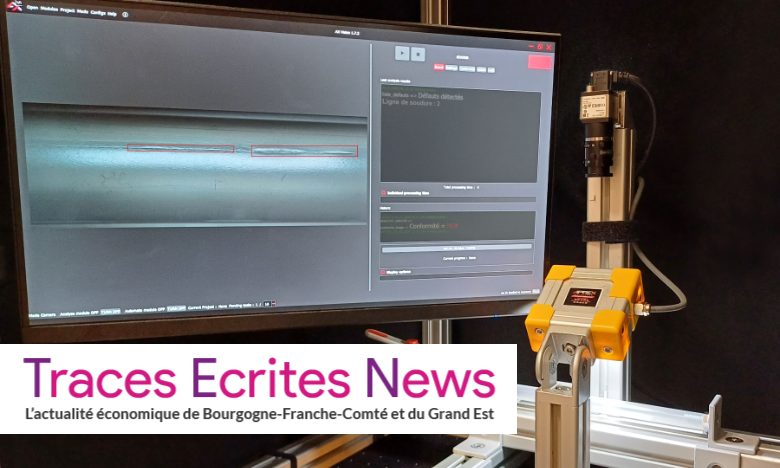
Photo © Aprex Solutions
Article by Philippe Bohlinger for Traces Ecrites News: Economic news from Bourgogne-Franche-Comté and the Grand Est region.
Published on November 13, 2024
Visual inspection technologies developed by the Lorraine-based company Aprex Solutions are improving the detection of non-conforming parts in industry through the use of artificial intelligence.
This fast-growing SME, with 28 employees and co-founded in 2017 by two PhDs in plasma physics, expects to hire 10 to 15 new employees by 2025.
Among the wave of startups created in recent years in Lorraine, Aprex Solutions stands out as one of the few examples to have turned promise into jobs—and in significant numbers. That’s because the company, co-founded by Romain Baude and Mikaël Désécures in 2017 in Nancy, has developed a technological innovation that addresses a fundamental need for manufacturers: improving the detection of defective parts.
Deployed by the young company—which now has 28 employees and is based in Pulligny (Meurthe-et-Moselle), a half-hour drive from Nancy—the technology stems from research conducted at the Jean Lamour Institute (CNRS-University of Lorraine). This powerful laboratory, home to 500 materials science researchers, provided fertile ground for the startup’s emergence.
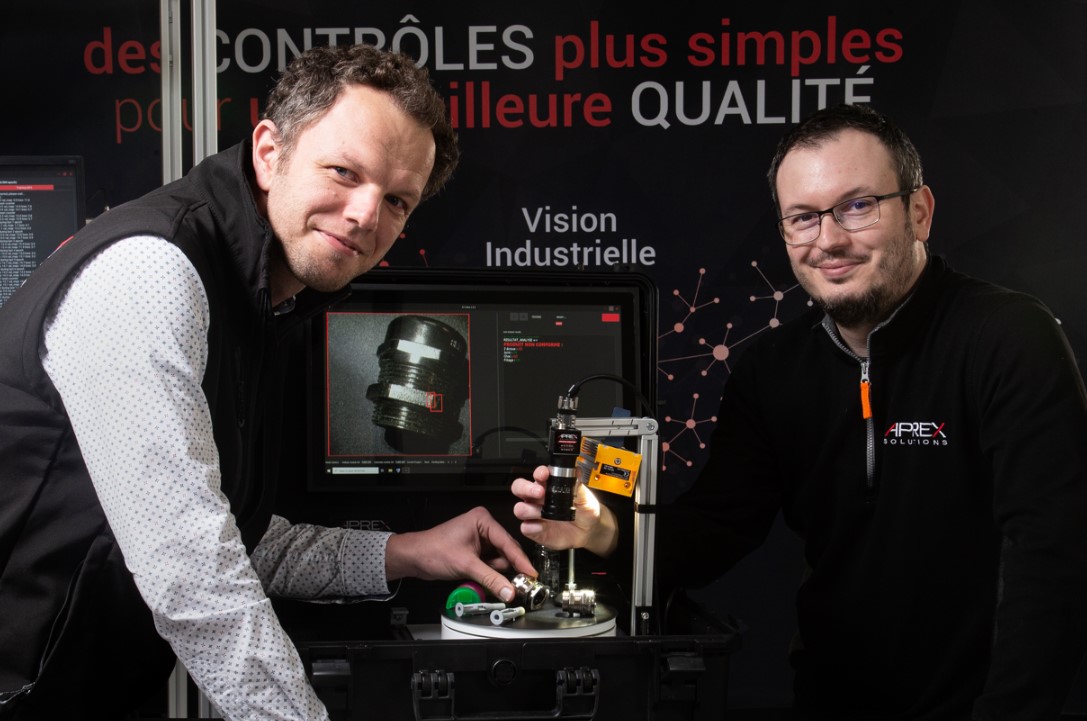
Crédit photo © Clotilde Verdenal
At the time, the goal was to monitor the interactions between the reactor wall and the plasma, a gas heated to a temperature of several million degrees. “We were convinced of the value of our innovation for observing whether particles from the wall ended up in the plasma. But we still felt a sense of frustration: what would happen to it if we changed our research focus?” recalls Romain Baude.
The two entrepreneurs then set out to make their technology more accessible with the help of the Jean Lamour Institute. The research center hosted their startup in its incubator during its first four years of operation. Aprex Solutions’ three-person research and development team continues to work closely with the Nancy-based laboratory.
The startup began to win over manufacturers and demonstrate the relevance of its solution in a playful way, for example by studying the trajectory of bubbles in a glass of champagne. It had to earn the trust of stakeholders whose tolerance margin for non-conforming products is extremely low—in the range of 1 in 1,000 or even 1 in 10,000. Quite a challenge!
Partnership with Saint-Gobain and Lisi Automotive
But the combination of three analytical methods in a single, in-house developed software program has been a hit, particularly with Saint-Gobain PAM, the renowned Lorraine-based manufacturer of cast iron pipes; industrial meat processor Herta; and Franche-Comté-based automotive supplier Lisi Automotive. Aprex Solutions has been working with the latter for three years, “to achieve a tolerance that, for them, is closer to 1 in 1 million,” notes Romain Baude.
The executive reveals one of the keys to the added value his company provides: the ability to have developed a software tool that combines three different analysis methods, “traditional dimensional and colorimetric measurements, and others using self-adaptive algorithms, better known today as AI, or artificial intelligence.” ”
However, the AI algorithms used by Aprex Solutions are very different from consumer-facing models like ChatGPT. For starters, they have no margin for error. “The challenge lies in the fact that companies—fortunately—have very few non-conforming products. Yet non-conformities are essential for training our algorithms and verifying their proper functioning. As a result, we have developed our own training software,” explains Romain Baude.
But AI isn’t the whole story. The company has also developed execution software and computer vision technology to select the sensors best suited to its measurements. These complementary technologies enable the capture of two- or three-dimensional images, thermographic images, the identification of a product’s chemical composition, and more.
To expand its workforce and extend Aprex Solutions’ presence in France and Europe, its co-founders announced last June that they had raised €2.1 million from venture capital funds (Yeast en Lorraine, Hand Partners, the Mermoz Group, and PBA-Paris Business Angels) and institutional and banking partners (Bpifrance, Banque Populaire, CIC, and BNP Paribas). The company, whose revenue figures have not been disclosed, anticipates hiring 10 to 15 new employees in 2025.
--------------------------------------------
We would like to extend our sincere thanks to TRACES ECRITES NEWS and Philippe Bohlinger for this coverage, and we warmly invite you to follow economic news from Bourgogne-Franche-Comté and the Grand Est region at: https://www.tracesecritesnews.fr/